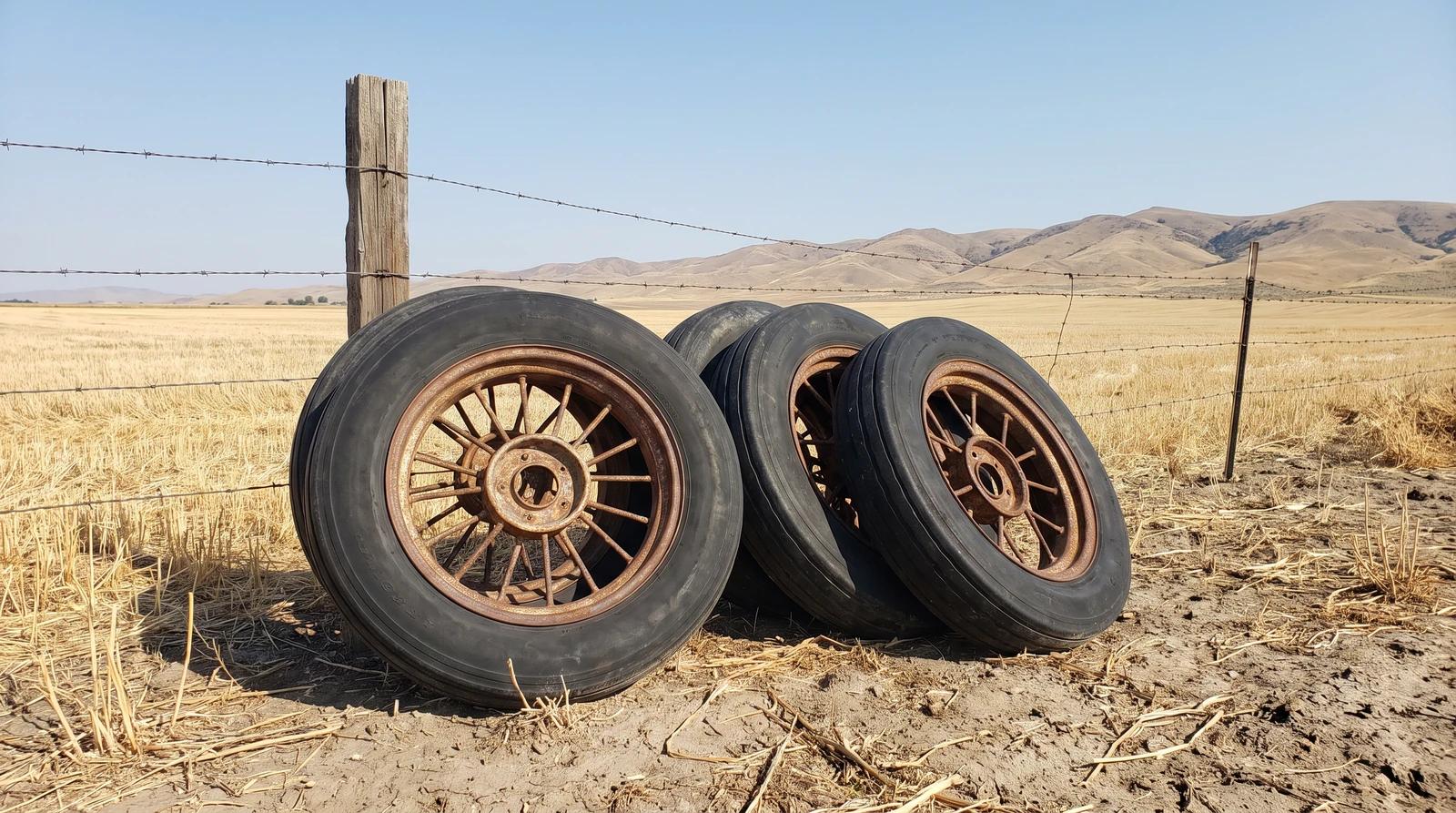
Farm Tire Disposal in Boise: Old Center Pivot Irrigation Tires
Once the water's shut off for the season, you finally get a good look at your pivot. Somewhere along the span there's usually a tire cracked down to the cords, sitting low in a rut it dug all summer. Swapping it is the easy part. Figuring out farm tire disposal in Boise and the rest of the Treasure Valley for a stack of old pivot tires is where people get stuck.
Pivot tires don't get talked about much. They aren't tractor tires and they aren't truck tires, so they tend to fall through the cracks. Here's what's worth knowing before you start a pile behind the shop.
Why pivot tires wear out in batches
A center pivot tire has a rough life. It crawls the same circle over and over, through mud in the wet spots and baked ground everywhere else.
The sun does as much damage as the miles. Our summers are hot and dry, and a tire that sits out in that all season starts to check and crack on the sidewalls long before the tread is gone. Then a hard freeze comes along and opens those cracks a little wider.
That's why a lot of growers end up replacing several towers at once. If one tire has dry rot, its neighbors usually aren't far behind. So the real question isn't how to get rid of a tire. It's how to get rid of a whole bunch of them, often still bolted to the wheels.
Tire disposal in Boise when the tires are still on the wheels
Most pivot tires come off the tower as a full wheel assembly. Plenty of folks just bolt on a new tire and wheel and set the old one aside.
That matters when it's time to get rid of them. Recyclers and drop-off sites generally want tires off the rim. Some won't take mounted tires at all, and others charge more for them. And breaking down a rusted pivot wheel that's been out in the weather for years isn't a quick job with hand tools.
So you've got two reasonable options. You can break them down yourself and keep the wheels, which makes sense if you've got a use for them or somewhere to sell scrap steel. Or you can leave them assembled and have someone haul them as they are. That costs a bit more in labor, but it saves you the wrestling.
Tip: Before you pull anything off the field, walk the span and mark which towers actually need new tires. Pulling only the bad ones keeps your pile smaller, and a smaller pile costs less to haul.
Timing it around the irrigation season
There's really one good window for pivot work. It's after the water's off in fall, or before you start back up in spring. Nobody wants to be changing tires on a running system in July.
That window works for hauling, too. In fall the fields are usually dry and firm enough to get out to the pile without sinking. Early spring is trickier. Field edges out around Kuna, Star and Middleton can turn soft fast, and a muddy pile is a lot harder to load.
If you're doing the swap in fall, try to get the old tires gone before winter. Tires in a pile collect water, and standing water in a tire turns into a mosquito nursery once it warms up. They're also a fire risk if they're sitting near hay or dry brush.
Can you just take them to the landfill?
Sometimes, yes. Landfills in Ada County and Canyon County each set their own rules on tires: whether they take them, how many they'll accept, whether rims are allowed, and what they charge. Those details change, so call ahead and check their current policy before you load the trailer.
Idaho also treats waste tires as their own category, with state rules on storing them in large numbers. That's one reason tires shouldn't go out with your regular trash or get buried at the back of the property.
If you've only got a couple of tires and a trailer, a dump run can make sense. Once it's a full set of towers, or the wheels are still on, the math changes. Between loading, the drive, the wait at the gate and the per-tire fees, a lot of growers decide their time is better spent somewhere else.
What moves the cost of farm tire disposal in Boise
We price by the space a load takes up and the work involved, not a flat number per tire. So what actually changes that?
Volume is the big one. A few tires is a small job. A whole span's worth is a bigger one.
Rims add weight and handling. Tires that are already off the wheels load faster.
Access matters more on farm ground than anywhere else. A pile next to the shop in Eagle is quick to load. A pile in the far corner of a field outside Caldwell, down a ditch bank road, takes longer to reach.
Condition plays a part too. Tires full of mud or water are heavier and messier, so tipping them over to drain ahead of time helps.
We'll come out, look at the pile and give you a firm price before we touch anything, with no hidden fees. Much of what we haul gets recycled instead of buried, which is good to know when you're getting rid of this much rubber.
Before the snow flies
Pivot tires wear out together, they usually come off still on the wheel, and the easiest time to deal with them is right after the water's off. Get them off the field before winter, check the landfill's rules if you're hauling them yourself, and don't let the pile sit long enough to cause trouble of its own.
If you'd rather hand it off, give Boise Tire Removal a call at (208) 314-3279. We'll take a look and give you a price. And if you end up hauling them yourself, that's fine too.
Need Bulk Tire Removal?
We provide commercial tire removal throughout Boise, Meridian, Nampa, Caldwell, and the surrounding Treasure Valley. Free site assessments and quotes.
Call (208) 314-3279More From Our Blog
Tire Disposal Boise: Sorting Sizes for Commercial Tire Removal
Run a shop or fleet yard? Here's why sorting tires by size before pickup makes commercial tire removal and tire disposal in Boise easier to plan and price.
Old Tire Removal and Tire Disposal in Boise: Safe Storage
Old tires piled by the fence until you deal with them? Here's how to store them safely before tire disposal in Boise, and mistakes to avoid while they sit.
Farm Tire Disposal Boise: Clearing Out Old Silage Pile Tires
Done using tires to hold down silage tarps? Here's how tire disposal works in Boise and the Treasure Valley for old bunker tires, mud, water and all.
